

Think Investors Are Buying Everything? Here’s the Real Story

Lately, it’s almost impossible to scroll online without running into the same claim:
“Big investors are buying all the homes.”
And if you’re a buyer who’s lost out on a few offers, that narrative probably feels pretty convincing. When prices are high and competition is fierce, it’s natural to assume big companies are quietly buying everything up.
But there’s a gap between perception and reality. What people think is happening doesn’t always match what the data actually shows.
So let’s take a closer look at what large institutional investors are really doing in today’s housing market—because the numbers tell a very different story than the headlines suggest.
The Stat Most People Aren’t Seeing Online
Let’s start with the number that actually matters. According to John Burns Research & Consulting (JBREC), large institutional investors—defined as owners of 100+ homes—accounted for just 1.2% of all home purchases in Q3 2025 (see graph below).
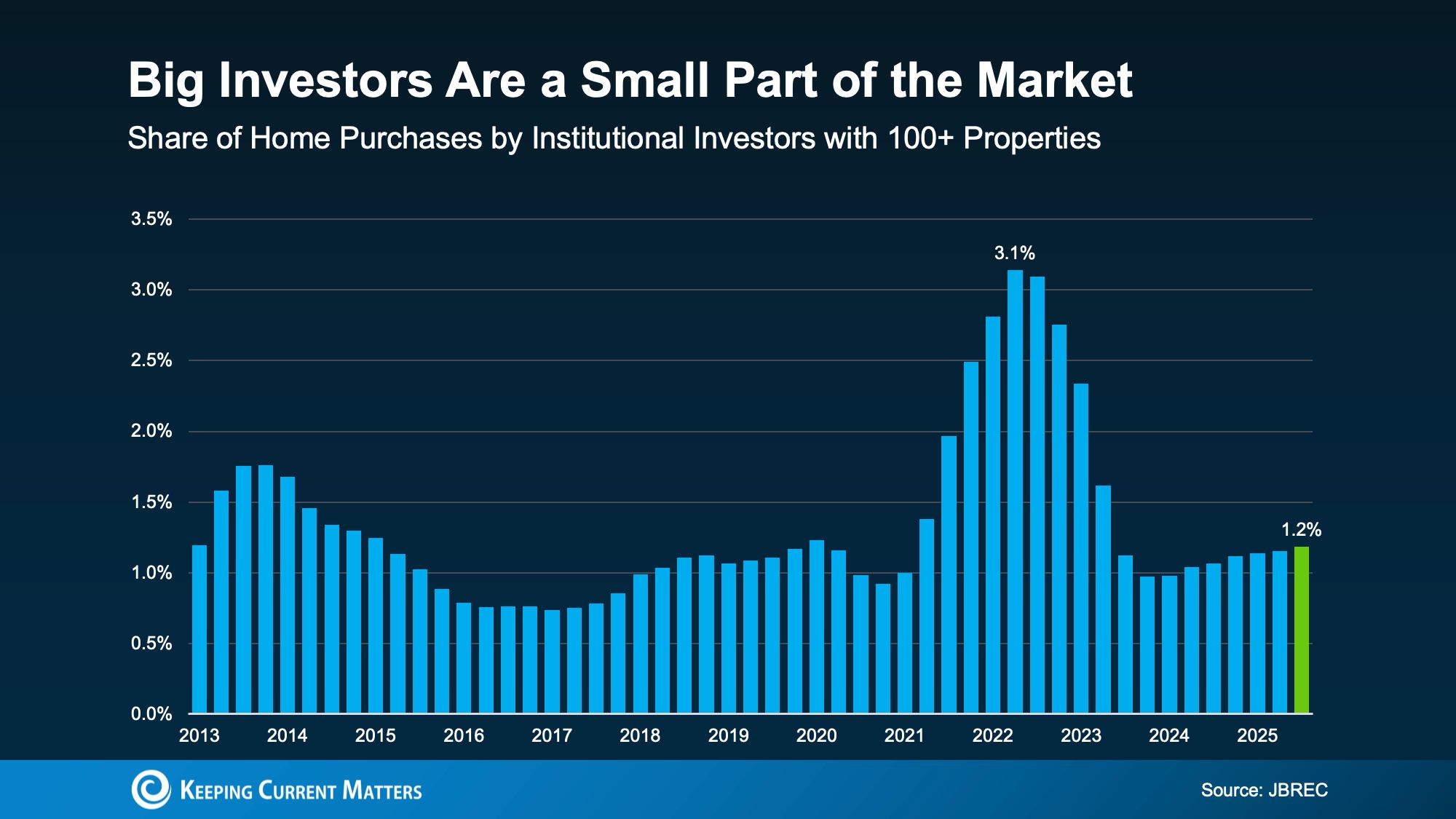
That’s it. For every 100 homes sold, roughly one was purchased by a large institutional investor.
And here’s the part that often gets overlooked: that level of activity is completely in line with historical trends. It’s not unusually high—and it’s actually well below the recent peak of 3.1% in 2022, which itself represented only a small slice of the overall market.
So while it may feel like big investors are everywhere, on a national level they make up a very small share of total home sales.
Why Investor Activity Draws So Much Attention
There are two key reasons this topic gets amplified so often:
- Investor activity isn’t evenly distributed. Investors tend to concentrate in specific markets, which can make competition feel especially intense for buyers in those areas—even if national numbers stay low. As Lance Lambert, co-founder of ResiClub, explains: “On a national level, large investors—those owning at least 100 single-family homes—control roughly 1% of total single-family housing stock. That said, in a handful of regional markets, institutional and large landlords have a much stronger presence.”
- “Investor” is a broad—and often misleading—label. Many headlines lump large Wall Street firms together with small, local investors—like someone who owns one or two rental properties. But those are very different buyers. In reality, most investors are local owners, not massive corporations. When all investors get grouped into a single statistic, it inflates the number and creates the impression that big institutions are dominating the market, even when they’re not.
Big investors do exist, and they do buy homes. But at a national level, they account for only a small fraction of total purchases—far less than most people assume.
The real affordability challenges are driven far more by supply and demand—and years of underbuilding—than by large institutions competing with everyday buyers. That’s why separating headlines from reality matters, especially when you’re deciding whether now is the right time to make a move.
Bottom Line
If you’re curious about what investor activity really looks like in your local market—and how it may (or may not) affect your buying or selling options—it’s worth having a real conversation with a local real estate expert who understands the data behind the headlines. National narratives don’t always reflect what’s happening on the ground in specific neighborhoods.
Sometimes, having the right context is all it takes to replace uncertainty with clarity and make more confident decisions.
{ "@context": "https://schema.org", "@type": "FAQPage", "mainEntity": [ { "@type": "Question", "name": "Are big investors really buying up all the homes?", "acceptedAnswer": { "@type": "Answer", "text": "No. According to John Burns Research & Consulting, large institutional investors—those owning 100 or more homes—made up only 1.2% of all U.S. home purchases in Q3 2025. That means for every 100 homes sold, about one was bought by a large institution." } }, { "@type": "Question", "name": "Is investor activity higher now than usual?", "acceptedAnswer": { "@type": "Answer", "text": "Not at all. The current 1.2% share is below the recent peak of 3.1% in 2022, which itself was still a small piece of the market. Overall, investor activity is in line with historical trends." } }, { "@type": "Question", "name": "If investors only buy a small share of homes, why does it feel like they’re everywhere?", "acceptedAnswer": { "@type": "Answer", "text": "Two reasons: (1) Concentration—investors often cluster in certain cities or neighborhoods, making their presence more visible in those areas; and (2) Broad definitions—headlines sometimes lump together all “investors,” from massive corporations to small local landlords with one rental property, which exaggerates the scale of institutional investment." } }, { "@type": "Question", "name": "How much housing do large investors actually control nationwide?", "acceptedAnswer": { "@type": "Answer", "text": "Only about 1% of the total single-family housing stock, according to ResiClub’s co-founder Lance Lambert. That’s a very small portion compared to everyday homeowners." } }, { "@type": "Question", "name": "What’s really driving high home prices and affordability challenges?", "acceptedAnswer": { "@type": "Answer", "text": "The main issue is supply and demand—years of underbuilding have created a shortage of available homes. While investors can play a role in specific markets, they’re not the main reason affordability has declined nationwide." } }, { "@type": "Question", "name": "What should a buyer or seller do to understand their local market better?", "acceptedAnswer": { "@type": "Answer", "text": "Talk to a local real estate expert who knows your area’s data and trends. National headlines can be misleading; your local housing market may tell a very different story." } }, { "@type": "Question", "name": "What’s the key takeaway about investor activity?", "acceptedAnswer": { "@type": "Answer", "text": "Big investors do exist, but they account for only a small fraction of home purchases. The nationwide housing story is much more about limited supply than corporate competition." } } ] }
Categories
Recent Posts

GET MORE INFORMATION
