

What’s Driving Mortgage Rates Right Now?

If you’re waiting for mortgage rates to drop significantly before buying, you could be waiting longer than expected. But don’t get discouraged—there’s an important number working in your favor right now. It’s called the spread, and understanding how it works could completely change the way you view today’s mortgage rates.
A Mortgage Rate Pattern That’s Lasted 50+ Years
Mortgage rates don’t move independently. They generally track the 10-year Treasury yield, which reflects how investors view the economy.
While other factors can influence rates from day to day, the broader pattern is clear: when the economy appears strong, Treasury yields typically rise over time. When uncertainty increases, they tend to fall. For more than 50 years, the 10-year Treasury yield and mortgage rates have followed a remarkably similar path (see graph below):
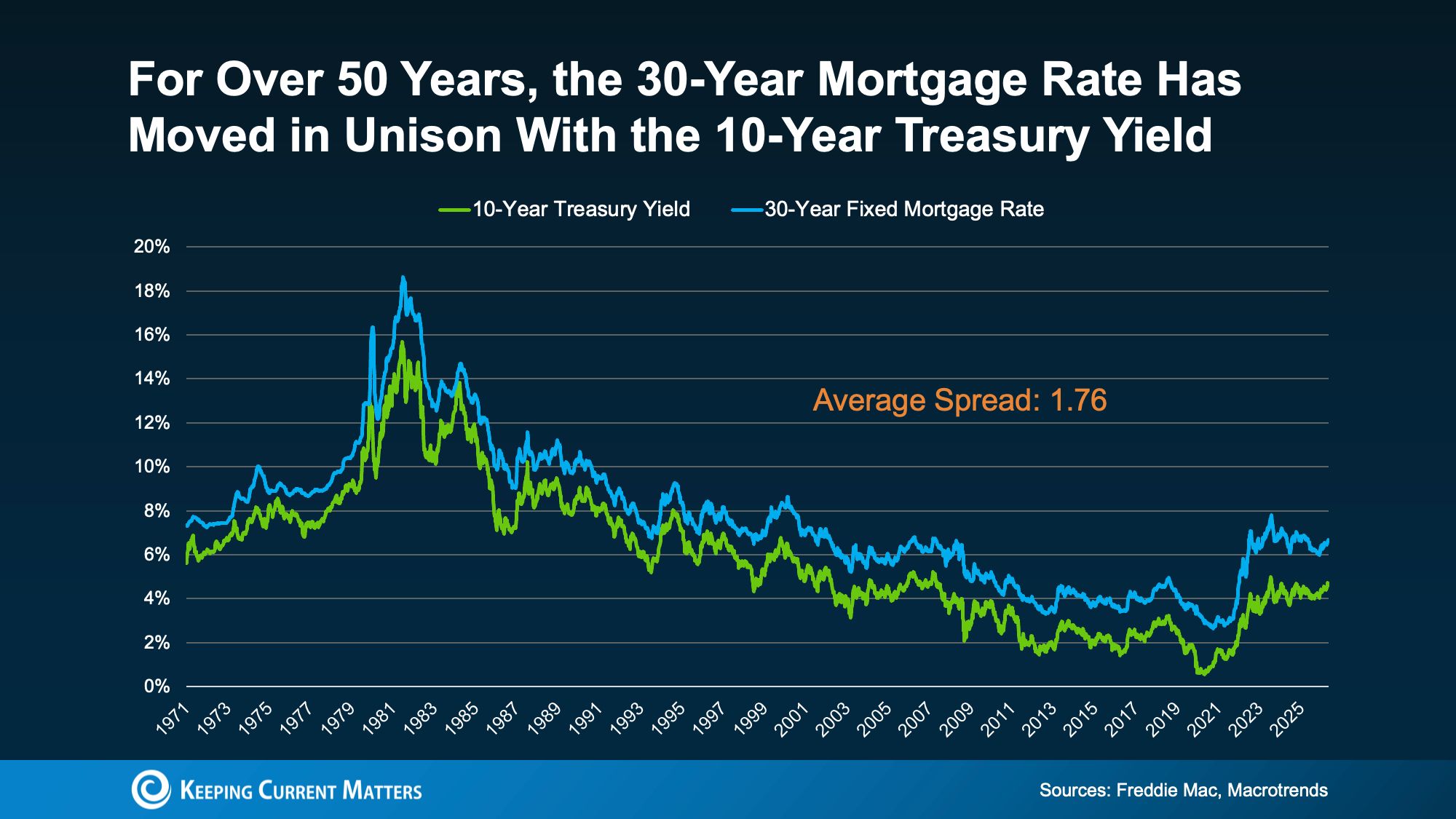
The difference between the two is known as the “spread,” which historically averages around 1.76 percentage points. That gap plays an important role in determining mortgage rates. When the spread widens, mortgage rates tend to rise higher than the Treasury yield alone would indicate. When it narrows, mortgage rates stay closer to the Treasury yield.
Why Mortgage Rates May Not Fall Significantly Anytime Soon
If you’re waiting for mortgage rates to fall significantly, the reality is that it may not happen anytime soon. One major reason is the spread between the 10-year Treasury yield and mortgage rates.
A few years ago, economic uncertainty caused that gap to widen significantly, reaching as high as 3.19 percentage points in 2023.
The encouraging news is that the spread has been narrowing recently. It’s now around 2.01 percentage points—only slightly above the long-term average of 1.76 (see graph below):
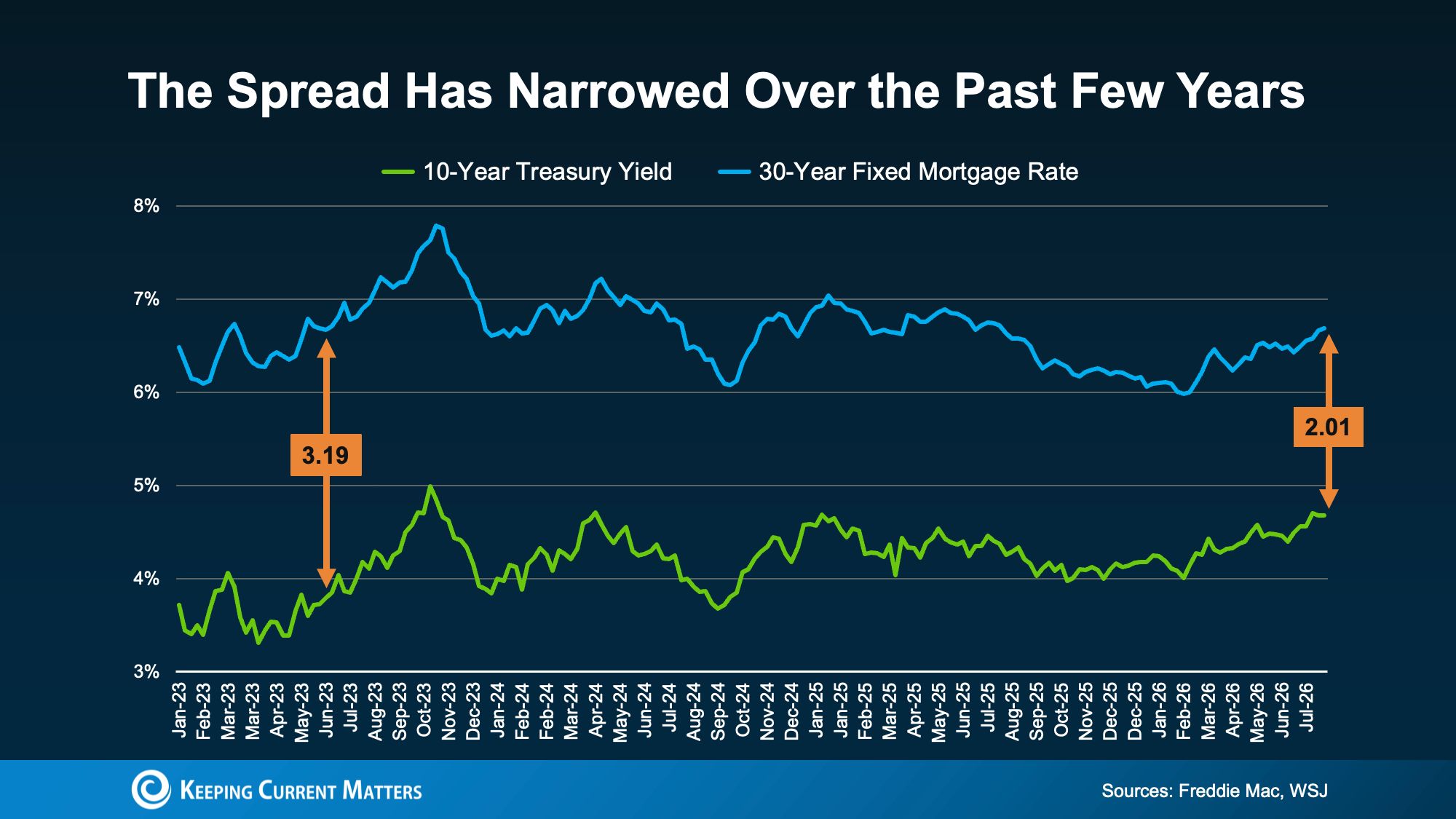
When the spread is wide, mortgage rates have more room to come down. But with the gap now closer to its historical average, there’s less potential for a significant drop.
What’s Keeping Mortgage Rates from Rising Higher
Today’s mortgage rate is largely determined by adding the spread to the 10-year Treasury yield. When either number changes, mortgage rates typically move with it. Here are three potential rates based on today’s 4.68% Treasury yield, showing just how much the spread can affect your borrowing costs (see graph below):
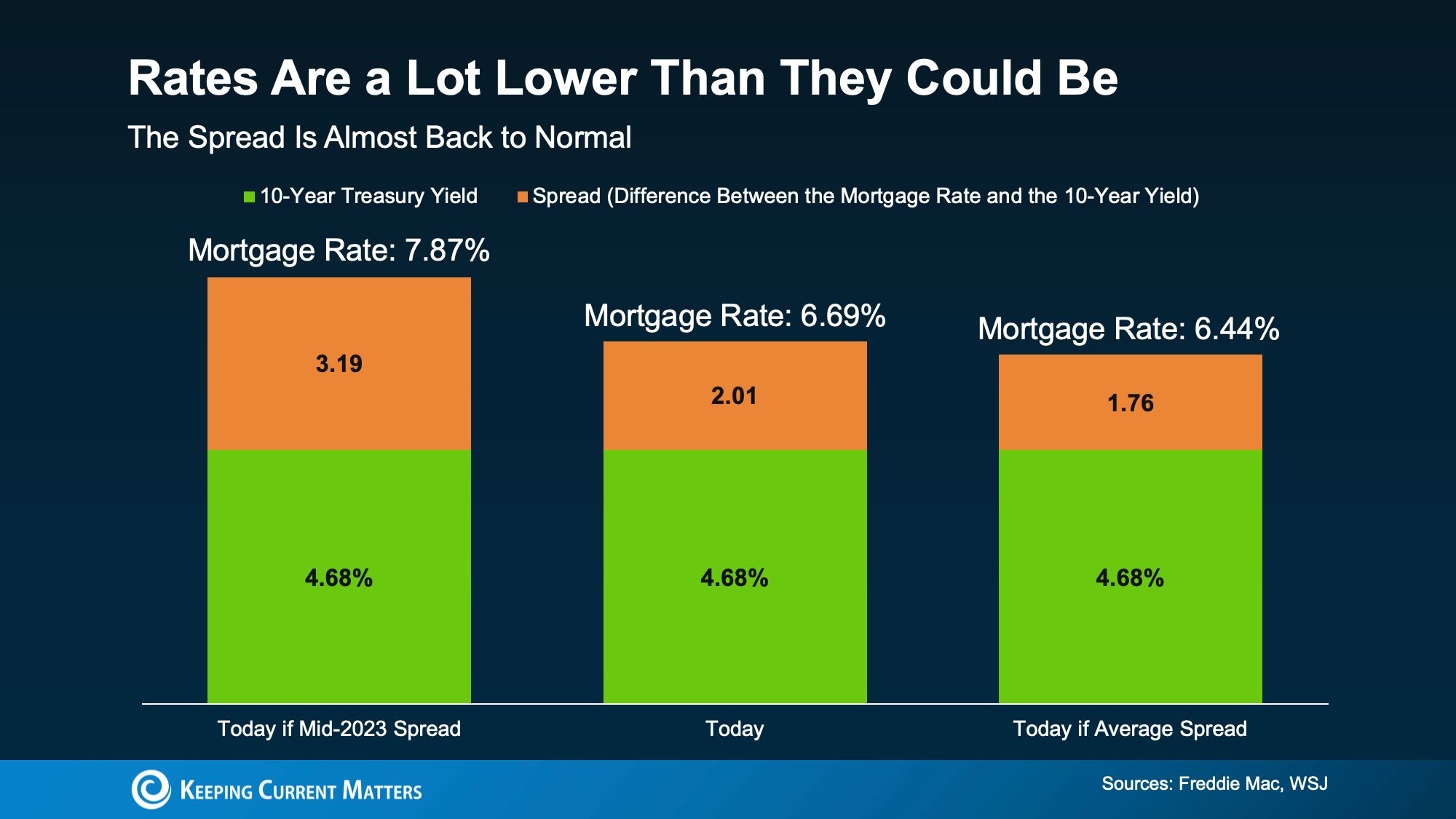
If the spread were still as wide as it was in 2023, mortgage rates would be approaching 8% today. That’s because the gap was more than a full percentage point larger than it is now.
But because the spread has narrowed, today’s mortgage rate is around 6.69%—the middle scenario shown in the visual. That creates a meaningful difference in your monthly payment compared with where rates could be if the spread were still as wide as it was in 2023. As Logan Mohtashami, Lead Analyst at HousingWire, explained:
“The narrowing mortgage-rate spread has been one of the biggest bright spots for housing in 2026.”
Now compare the middle bar with the third. If the spread returned to its long-term average, mortgage rates would be around 6.5%—only about a quarter point below where they are today. In other words, most of the realistic rate improvement from a narrowing spread has likely already occurred.
In short, the narrowing spread that’s keeping mortgage rates from approaching 8% is also one of the main reasons they may not drop much further.
Bottom Line
Mortgage rates may not be as low as you’d like, but the narrowing spread has kept them from climbing even higher. To understand how today’s rate could affect your monthly payment and buying power, connect with a trusted local lender.
Categories
Recent Posts

GET MORE INFORMATION
